 Cesar

What causes stucco to crack?
Most stucco cracks come from normal movement: the house settling, concrete or framing shrinking, temperature swings, and vibration. Poor original mixing or curing, and moisture getting behind the stucco, also contribute. Hairline cracks are usually cosmetic, while wide, stair-step or recurring cracks need a closer look to rule out a deeper problem.
Not every crack means trouble, but every crack lets water in if left open. That is why even cosmetic cracks are worth sealing before the next rainy season.
- Hairline cracks: common, often from curing and temperature changes, and sealed with flexible patching material
- Cracks at the corners of windows and doors: stress concentrates there and they often return if the opening is not properly reinforced
- Wide or stair-step cracks: can signal settling or foundation movement, so Cesar will tell you what he sees and when to bring in a specialist
- Bubbling, soft or stained areas: usually moisture behind the stucco, which has to be traced to its source
- Chipped or missing sections: impact, trim failure or water damage
Can stucco be patched, or does a section need to be redone?
Small cracks and chips can be patched. When stucco is loose, hollow-sounding, stained by moisture or missing in larger areas, the damaged section should be cut back to sound material and re-stuccoed. Patching over unsound stucco will fail again, so Cesar checks by tapping and probing the wall.
| Condition | Typical approach |
|---|---|
| Hairline cracks | Clean, fill with flexible patch material, then paint |
| Wider cracks | Open slightly, fill and reinforce, then blend the texture |
| Chips and small holes | Patch in layers and match the texture |
| Hollow or loose stucco | Cut out back to solid material and re-stucco the section |
| Moisture-damaged areas | Find the source, repair the backing and re-stucco |
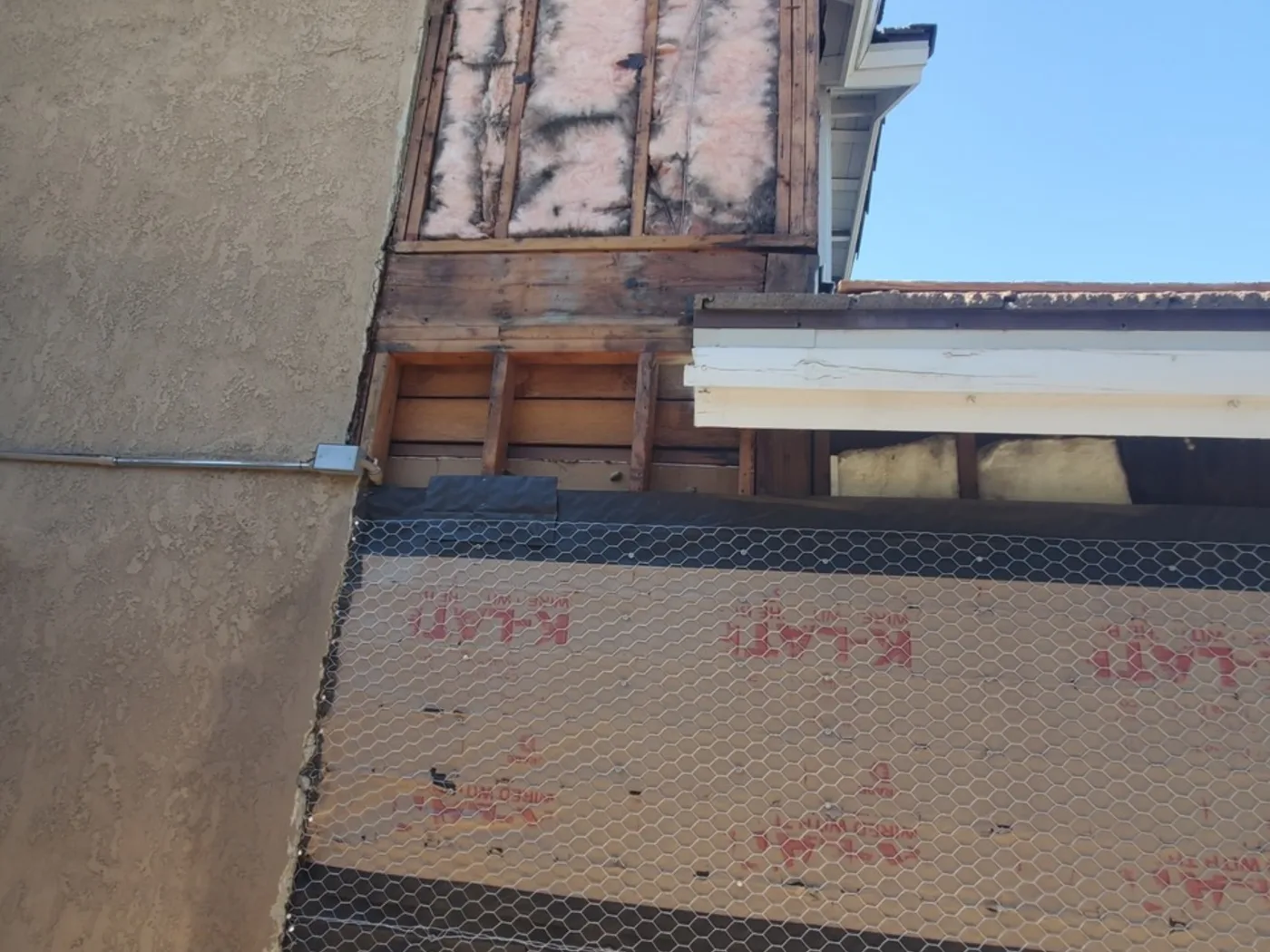
If the wall has been opened down to lath, as in the photo above, new stucco goes on in coats: a scratch coat, a brown coat, then the finish coat, with curing time between layers.
Can you match my existing stucco texture and color?
We can match common finishes such as smooth, sand, lace and dash textures, and blend new stucco into the old, though an exact match is not always possible. Older stucco has weathered, so the most reliable way to hide a repair is to repaint the whole wall section after the patch cures.
Texture is created by how the finish coat is applied: troweled, sprayed, dashed or floated. We test a sample on the wall, compare it in daylight and adjust before committing to the repair.
Color is harder. Stucco fades and collects dirt, and fresh material is nearly always lighter or different in tone than the surrounding wall. If the existing wall is painted, repainting the repaired section edge to edge, or the whole wall if needed, gives the best result. Painting is one of our services, so the two jobs can be planned together.
How long does stucco repair take?
A small crack or patch repair can be done in a day, while re-stuccoing a larger section takes several days because each coat has to set and cure before the next. Weather matters, since stucco needs the right temperature and moisture to cure well. Cesar gives you a realistic schedule at the free estimate.
Stucco is a material that rewards patience. Fresh stucco cures slowly, often lightly misted so it does not dry too fast, and paint should only go on once the surface has cured as the product directions say.
Rain, wind and very hot or cold weather all affect the schedule. We plan around forecasts, and if conditions are wrong for the work, we reschedule rather than risk a patch that cracks.
What causes water damage behind stucco, and can it be fixed?
Water usually gets in through cracks, failed caulk at windows and doors, poor flashing, roof or gutter leaks, and sprinklers hitting the wall. Behind the stucco it can rot framing and damage insulation. Fixing it means finding the source, drying and repairing the backing, then re-stuccoing the area.
Signs of trouble include dark staining, bulging or soft stucco, efflorescence, which is a white chalky deposit, and cracks that keep reopening in the same place.
Cesar will tell you what he sees and whether the repair is within our scope. Widespread moisture damage, mold or structural rot is scoped separately, and some situations call for a roofer, plumber or other specialist first.
What should I do before the stucco repair visit?
Photograph the cracks and stains, note when you first saw them and whether they change after rain, and clear plants, furniture and decorations away from the wall. Turn sprinklers off near the area. If you know the paint color, brand or texture style, share it, since it speeds up matching.
- Take close-up and wide photos of each problem area
- Trim plants and move items at least a few feet from the wall
- Check whether sprinklers spray the wall and aim them away
- Locate leftover paint or the color name and brand
- Tell us about past repairs or leaks in the same area
What is and is not included
Included
- Inspection of cracks, chips, hollow spots and moisture signs
- Crack sealing and patching with flexible repair material
- Cutting out damaged stucco and re-stuccoing sections in coats
- Texture blending to match the surrounding wall as closely as possible
- Painting of the repaired area when you want it done in the same job, plus cleanup
Not included
- Foundation, structural and framing repairs, which are scoped separately, and Cesar will tell you up front if a crack points that way
- Roof, gutter or plumbing repairs that cause the moisture, which belong to the relevant trade
- Mold remediation and testing, which are for specialists
- Whole-house re-stucco and large wall systems, which are confirmed case by case at the estimate
Where we offer stucco repair
We provide stucco repair across the San Gabriel Valley and the Inland Empire. Pick your city for local details:
Related handyman services
Related guides
Frequently asked questions
Do you offer free estimates for stucco repair?
Yes. Estimates are always free and carry no obligation. Call (909) 775-1885 or use the quote form on the homepage, and Cesar will look at the job, confirm the scope and explain what it involves before any work is scheduled.
Are stucco cracks a serious problem?
Hairline cracks are usually cosmetic, though they should still be sealed so water does not get in. Wide, stair-step or recurring cracks can mean movement, and Cesar will tell you plainly what he thinks when he sees them.
Will the patch be visible after painting?
A good patch should blend in. We match the texture and then recommend painting the repaired wall section edge to edge, since fresh stucco and old paint never match perfectly. We check the result in daylight before we call it done.
Can you paint my stucco after the repair?
Yes. Exterior painting is one of our services. Stucco needs to cure before it is painted, and the right exterior paint for masonry helps the finish last, so we plan the timing with you.
Do I need to repair cracks before it rains?
It is a good idea. Open cracks let water into the wall, where it can cause damage you cannot see. Sealing cracks before the wet season is simple protection compared with repairing moisture damage later.
How soon can the work start?
Most jobs start within 48 to 72 hours of you accepting the estimate. Larger or material-dependent projects can take longer, and Cesar will give you a realistic start date at the estimate. We are available Monday through Sunday, 8 AM to 8 PM.
Is the work covered by a warranty?
Every project is backed by our craftsmanship warranty. If something we did is not right, we come back and make it right. We are glad to walk you through how it applies to your specific job when we give you the estimate.
Which areas do you cover for stucco work?
We serve Pasadena and the wider San Gabriel Valley, the Inland Empire and nearby communities. See the full list on our areas page, or call (909) 775-1885 with your city and we will confirm we can reach you.
Ready to get stucco repair taken care of? Estimates are free.