 Cesar
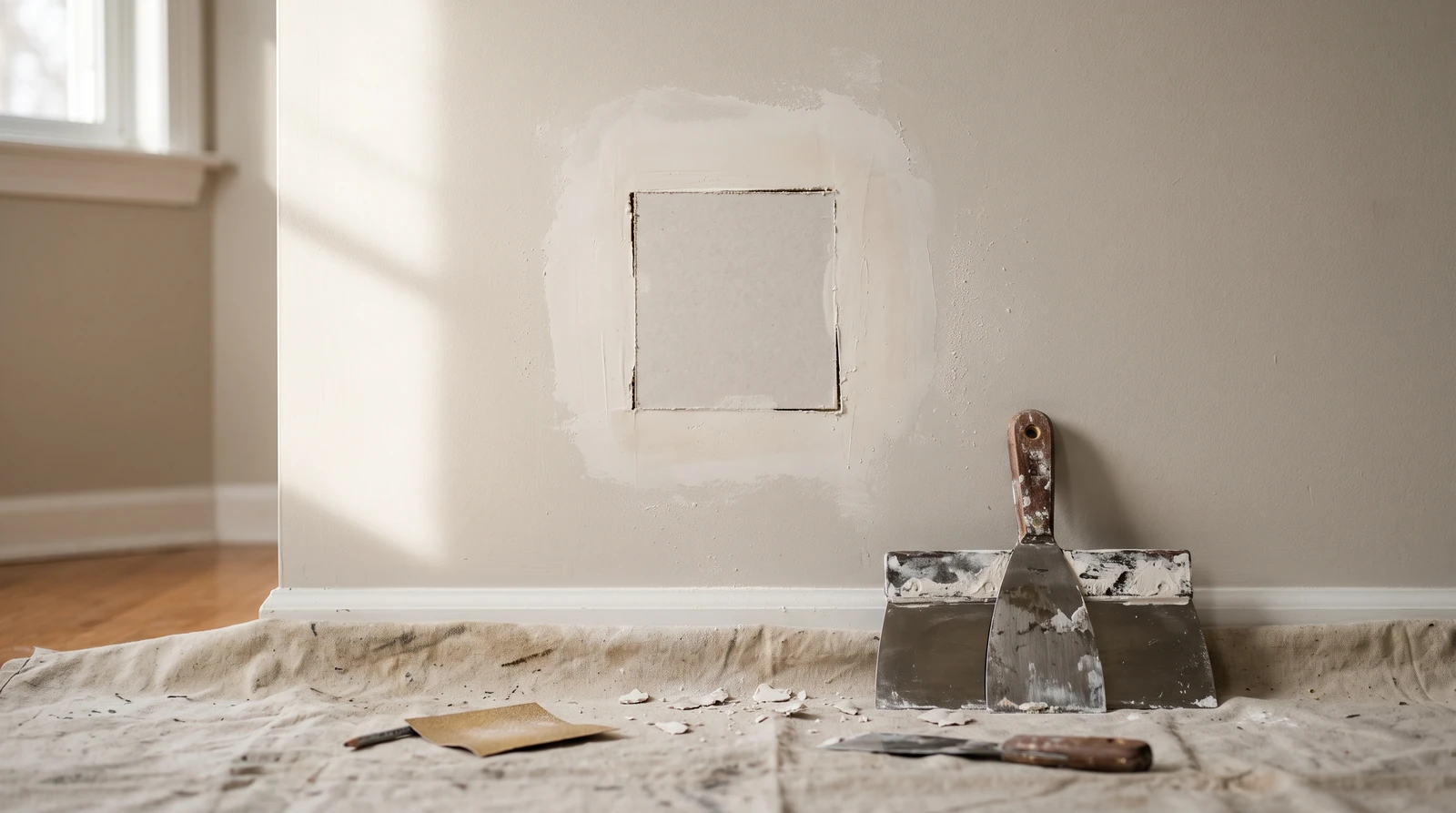
How do I know if drywall can be patched or needs to be replaced?
Patch when the board is dry, firm and the hole is small, roughly the size of a fist or less. Replace a section when the damage is larger, the board is wet, soft or crumbling, or the same crack keeps coming back. Compound alone cannot restore strength or stop moisture.
Press gently around the damage with your thumb. Solid, dry board around a small hole is a good candidate for a patch. If the paper face is bubbling, the gypsum feels spongy, or the edges crumble when you touch them, the board has lost its strength and a patch will only hide the problem.
| What you see | Usually | Why |
|---|---|---|
| Nail pops, dings and small dents | Fill and spot-prime | The board is sound; this is a surface fix |
| Hole up to about the size of a fist | Patch with a backing piece | Enough solid board around it to hold the patch |
| Hole larger than a hand, or an opened wall | Replace a section | A big patch cannot span the gap without cracking |
| Soft, stained or bubbling board | Replace the section | Wet board loses strength and stains through new paint |
| Crack that reopens after repair | Find the cause, then re-tape or replace | Movement or moisture is still at work |
What does a drywall patch involve?
A patch has four stages: square up the damage, fit a backing piece so the new board has something to attach to, apply joint compound in several thin coats with drying time between each, then sand, texture and prime. Rushing the drying is the most common reason a patch shows through paint.
The order matters more than the materials. For a typical repair, the steps look like this:
- Cut the damaged area into a clean square or rectangle and remove loose paper and crumbs.
- Fasten a backing strip behind the opening, or cut back to the nearest framing.
- Fit a piece of board of the same thickness so it sits flush with the wall.
- Tape the seams and spread thin coats of compound, feathering each one wider than the last.
- Sand smooth, match the surrounding texture, then prime the whole repair.
Thin coats are what make a repair disappear. One thick coat shrinks, cracks and leaves a ridge that shows when light rakes across the wall, especially on ceilings.
When is replacing a section the better choice?
Replacing a section is better when a hole is large, when water has softened the board, when old patches have failed repeatedly, or when a wall was opened for plumbing or electrical work. A fresh piece fastened to the framing gives a flat, strong surface that compound alone cannot.
In practice we cut back to the middle of the nearest studs so the new board can be screwed to solid framing on both edges. The seams are taped and finished just like a full wall. It takes longer than a small patch, but it is the right fix when the board itself has failed.
- Water-stained ceilings or walls where the board is soft to the touch
- Holes from removed fixtures, vents or door swings that are larger than a hand
- Corners crushed by furniture or doors, where the metal bead underneath is bent
- Old patches that have cracked, bubbled or sunk more than once
If a stain is involved, fix the source first. New drywall over an active leak will stain and soften again, and a leak at a pipe or roof belongs to a plumber or roofer before it belongs to us.
Why does drywall crack, and will a repair stay put?
Most cracks come from movement, moisture or poor original taping. Hairline cracks along seams and at the corners of doors and windows are common as a house settles and the seasons change. A proper repair usually stays closed, but a house that keeps moving can show the crack again.
Cracks that run up from the corner of a door or window are usually movement. Hairline cracks along taped seams are often cosmetic and come from the tape and compound shrinking or flexing. Long cracks that grow, or cracks with a step where one side sits higher than the other, are worth having looked at before anything is patched.
Southern California homes see seasonal swings between cool nights and hot days, and many older houses in Pasadena, Altadena and Monrovia have settled for decades. Both can show up as seam cracks. Re-taping the seam rather than just filling the line gives the repair a better chance of staying closed.
Can I patch drywall myself, and when should I call a pro?
Small holes, nail pops and dents are reasonable DIY jobs if you are patient with the drying time. Call a pro for large holes, ceilings, water damage, texture you need to match, or any older home where sanding could disturb hazardous material. The finish is the hard part, not the cutting.
The cutting and fitting is easy to learn. The skill is in the finishing: feathering compound so no edge shows, then matching an orange peel, knockdown or skip-trowel texture to the rest of the wall. Ceilings are harder than walls because light rakes across them and shows every ridge.
A note on older houses: texture and joint compound in homes built before the 1980s can contain asbestos, and paint in homes built before 1978 may contain lead. If the surface will be sanded or cut, have it tested by a qualified specialist first. We will tell you if we think that step is needed.
We repair drywall as part of our drywall repair service and can pair it with interior painting so the finished wall is painted corner to corner. Estimates are free.
Related services
Serving Pasadena and Monrovia, and the wider San Gabriel Valley and Inland Empire.
More guides
- Getting Your Fence and Gate Ready for Santa Ana Wind SeasonA pre-season check of posts, fasteners, hinges and latches, plus how to tell a quick fix from a repair that should not wait.
- Rental Turnover Checklist: Repairs to Make Between TenantsA room-by-room landlord checklist and a sensible work order for getting a rental ready between tenants.
- Repairs Worth Making Before You Sell Your Home in the San Gabriel ValleySmall, visible and inspection-sensitive repairs usually come first; big remodels usually do not belong on a pre-listing list.
Frequently asked questions
How big a hole can be patched instead of replaced?
As a rule of thumb, holes up to roughly the size of a fist can be patched with a backing piece. Anything larger, or any hole in wet or crumbling board, is better handled by replacing a section so the repair has solid material on every side.
Do I have to repaint after a drywall repair?
Usually, yes. New compound and primer never match aged paint exactly, so for the best result paint the whole wall or ceiling from corner to corner rather than only the patch.
How long does a drywall repair take?
A small patch is often finished in a day or two, and most of that time is waiting for compound to dry between coats. Larger sections take longer because each coat needs to cure before sanding.
Why does my patch show through the paint?
The usual causes are thick coats that shrank, edges that were not feathered wide enough, skipped primer, or texture that was not matched. All of these are fixable by re-skimming and repainting the area.
Should the leak be fixed before the drywall?
Always. Repairing board over an active leak just repeats the stain and softening. Stop the source first, let the framing dry fully, then repair or replace the board.
Have a question about your own home? Estimates are free.