 Cesar
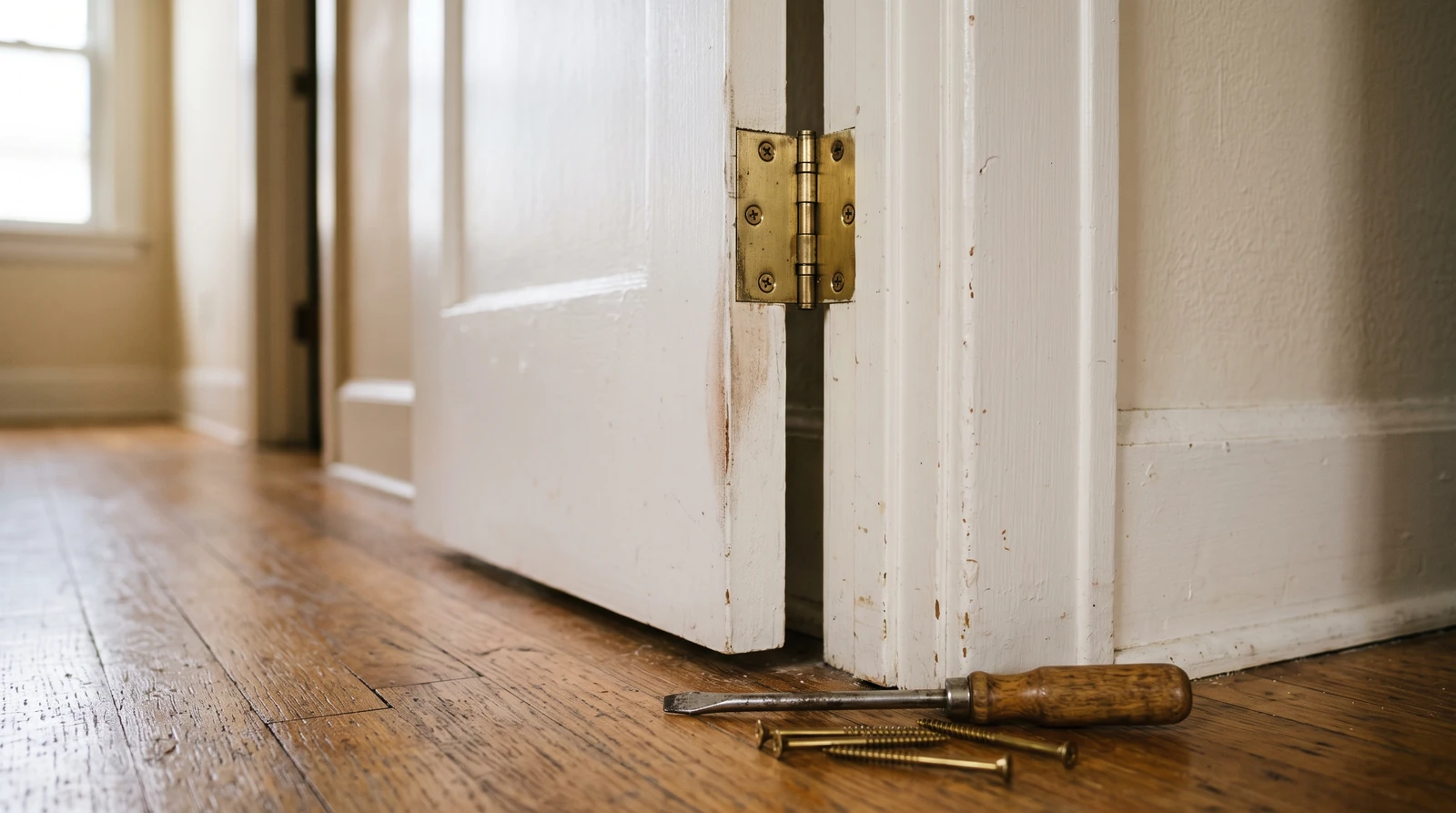
Why does my door stick or rub against the frame?
The most common causes are loose hinge screws that let the door sag, wood that has swollen with humidity, built-up layers of paint on the edges, and a frame that has shifted as the house settled. Finding where the door rubs tells you which cause you are dealing with.
Close the door and look at the gaps around it. They should be even, about the thickness of a coin. A tight spot at the top corner on the latch side usually means the door has dropped on its hinges. A tight spot all along the latch edge points to swelling, paint or a frame that has moved.
To find the exact rub points, slide a sheet of paper around the edge of the closed door. Wherever the paper catches, the door is touching. A pencil mark or a strip of painter's tape on the frame will also transfer to the door edge and show you where to work.
How can I tell which problem I have?
Match the symptom to the cause. A door that rubs at the top latch corner has usually sagged on loose hinges. A door that is tight everywhere has swollen or collected paint. A latch that misses its hole points to hinges or a misaligned strike plate. Check hinges first because they are the easiest fix.
| Symptom | Likely cause | First thing to try |
|---|---|---|
| Rubs at the top corner, latch side | Loose hinge screws, door has sagged | Tighten the screws, especially the top hinge |
| Tight along the whole latch edge | Swelling or paint buildup | Sand or plane the edge lightly, then seal it |
| Latch bolt hits the frame, not the hole | Door sag or strike plate out of line | Fix the hinges, then adjust the strike plate |
| Rubs at the bottom | Flooring change, dropped door or swelling | Check for a new rug or flooring, then the hinges |
| Door swings open or closed on its own | Frame out of plumb or a bent hinge pin | Check with a level; adjust or replace the hinges |
What are the simple fixes I can try first?
Start with the hinges. Tighten every screw, and if a screw spins freely, replace it with a longer one that bites into the wall stud behind the frame. Then clean and lubricate the latch, check the strike plate alignment, and only sand or plane the door once you know the hinges are solid.
A longer hinge screw, about three inches, pulls the door and frame back toward the framing behind them. It is the single most effective fix for a door that has sagged, and it takes a few minutes.
- Tighten all hinge screws. Replace any that spin freely with a longer screw into the stud.
- Close the door and recheck the gaps. If the rub is gone, you are done.
- If the latch still misses, mark where the bolt hits the frame and move the strike plate to match.
- Spray a dry lubricant on the latch and hinges if they are stiff or noisy.
- Only if the door is still tight, mark the rub point and sand or plane a little at a time.
Take off less than you think you need. Planing too much leaves a visible gap that cannot be put back.
Why does the weather make my door worse?
Wood absorbs moisture and swells, then shrinks again as it dries. Even in dry Southern California, coastal air, rainy weeks and bare, unsealed edges can make a wood door fit tighter for a while. If a door only sticks in some seasons, swelling is the likely cause, and sealing the edges helps.
The top and bottom edges of a door are the ones people forget. They are often left unpainted or unsealed, and they soak up moisture fastest. Whenever a door is trimmed, we seal every cut edge with paint or sealer so the problem does not come straight back.
Many houses in the San Gabriel Valley are decades old, and settling over the years can leave frames slightly out of square. A door that fit perfectly in one season and sticks in another is often the combination of a frame that has moved a little and wood that swells and shrinks a little.
When does a sticking door need a pro or a replacement?
Call a pro when the frame itself is out of square, when the door is warped or cracked, when rot has reached the jamb, or when you have tried the simple fixes and the latch still will not catch. A door that no longer fits its opening may be cheaper in time and effort to replace than to keep trimming.
- The gap around the door is clearly wedge-shaped, wide at one end and tight at the other
- The door itself is bowed, split or soft at the bottom edge
- The jamb is cracked, rotted or pulling away from the wall
- Exterior doors that let in drafts, light or water at the sill
We adjust, rehang and replace interior and exterior doors as part of our door installation and repair service, and we can paint or seal the new edges through our painting service. Cesar will tell you plainly whether adjusting the door you have is the better choice. Estimates are free.
Related services
Serving Altadena and Arcadia, and the wider San Gabriel Valley and Inland Empire.
More guides
- Getting Your Fence and Gate Ready for Santa Ana Wind SeasonA pre-season check of posts, fasteners, hinges and latches, plus how to tell a quick fix from a repair that should not wait.
- Rental Turnover Checklist: Repairs to Make Between TenantsA room-by-room landlord checklist and a sensible work order for getting a rental ready between tenants.
- Repairs Worth Making Before You Sell Your Home in the San Gabriel ValleySmall, visible and inspection-sensitive repairs usually come first; big remodels usually do not belong on a pre-listing list.
Frequently asked questions
Is it okay to plane the top of a door?
Yes, if the door truly rubs there, but do it last. Take off small amounts, then seal the bare wood so it does not absorb moisture and swell again.
Why will my door not latch even though it closes?
Usually the latch bolt is hitting the frame next to the strike plate hole. That means the door has sagged on its hinges or the plate is a little out of line. Fix the hinges first, then move the plate if needed.
Can I fix a sagging door myself?
Often, yes. Tightening the hinge screws or replacing one with a longer screw into the stud fixes many sagging doors in minutes. If the frame or the door itself is damaged, it is worth having someone look at it.
Does paint make doors stick?
It can. Repeated repainting builds up layers on the edges and in the hinge area. Stripping or sanding back the buildup on the edge and hinge side often frees the door.
How long does a door repair take?
A simple adjustment is usually done in one visit, often within the hour. Rehanging or replacing a door and its trim takes longer, and Cesar gives you a realistic schedule at the free estimate.
Have a question about your own home? Estimates are free.